
Retatrutide vs EloraTZP
Which Third Pathway Matters?
Oct 4, 2026 · @Martina Berger
I recently wrote about EloraTZP, Eli Lilly's experimental combination of tirzepatide and eloralintide. Afterward, a more personal question stuck with me: how does it actually differ from retatrutide, the drug I'm taking now?
On paper, both are "triple-acting." But their third hormonal pathway is completely different:
Retatrutide: GLP-1 + GIP + glucagon
EloraTZP: GLP-1 + GIP + amylin
That third pathway may be the most important difference between them.
What does "incretin" mean?
Incretins are hormones the gut releases after we eat to help the body handle incoming food. The two main ones are GLP-1 and GIP. Both help stimulate insulin release when blood sugar rises, and GLP-1 also influences appetite, fullness, and how quickly food leaves the stomach.
In simple terms, incretins tell the body: Food has arrived — get ready to handle it.
Semaglutide works mainly through GLP-1. Tirzepatide works through both GLP-1 and GIP. Retatrutide also activates GLP-1 and GIP, but its third target, glucagon, is not an incretin. EloraTZP pairs tirzepatide, an incretin-based therapy, with eloralintide, an amylin-based therapy.
So these aren't simply two versions of the same incretin treatment.
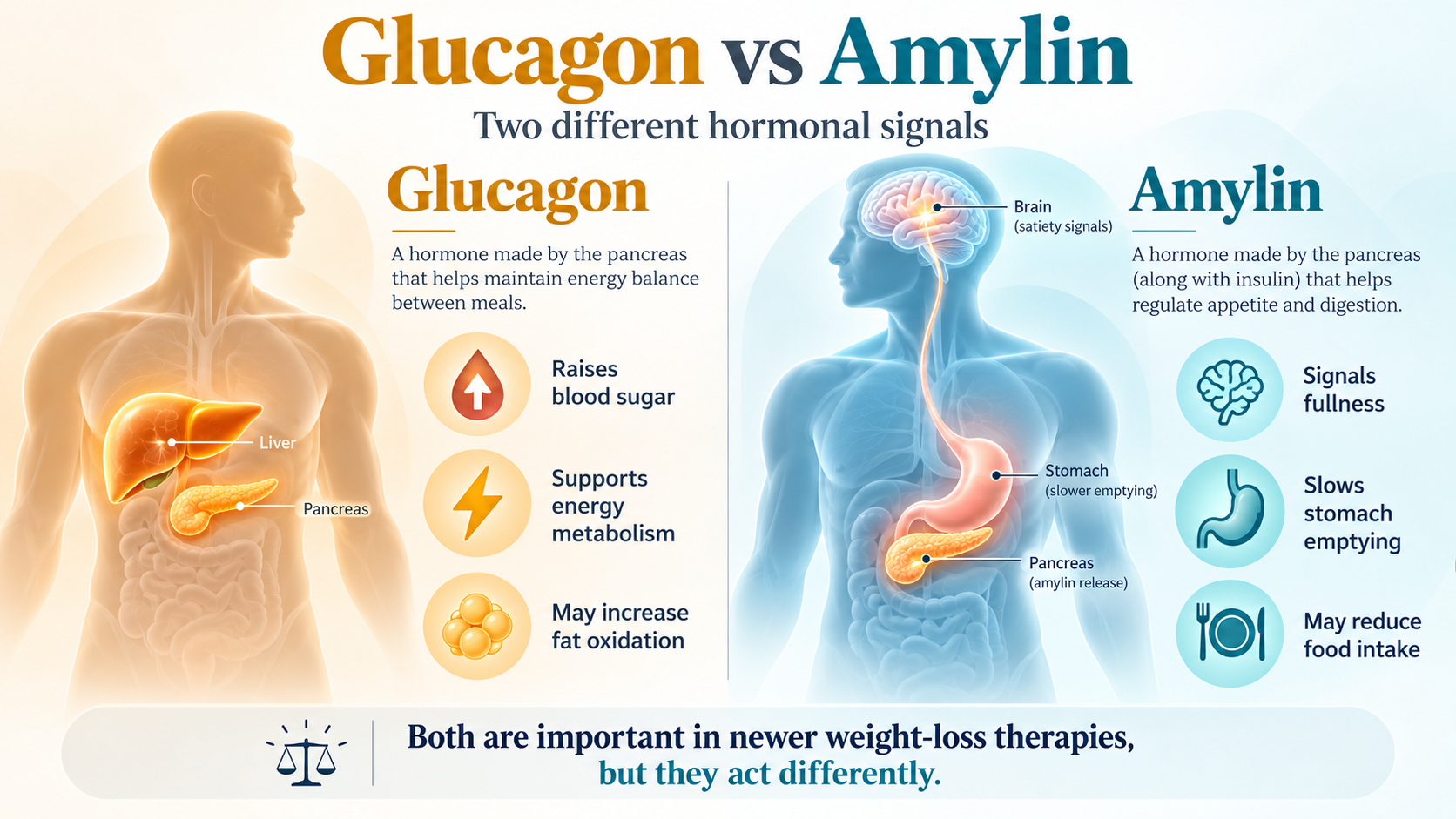
Glucagon vs. amylin
Retatrutide adds glucagon receptor activity to GLP-1 and GIP. That's interesting because glucagon may do more than curb appetite: it also plays a role in energy metabolism and fat burning.
EloraTZP takes a different route, adding amylin signaling to tirzepatide. Amylin is released from the pancreas after eating and helps tell the brain you're full.
Put simply, retatrutide layers glucagon-driven metabolic effects on top of GLP-1/GIP signaling, while EloraTZP layers an extra amylin-based fullness signal on top of it. Neither approach is necessarily better. They're two different ways of building beyond GLP-1 and GIP.
And then there are the numbers
In people with obesity or overweight and type 2 diabetes, EloraTZP produced up to 23.3% average weight loss over 48 weeks. In a separate Phase 3 study in a similar population, retatrutide produced up to 20.8% over 80 weeks.
The EloraTZP number certainly catches your eye. But I wouldn't treat 23.3% versus 20.8% as a competition. These were different trials, with different designs, dosing schedules, and treatment lengths.
What interests me more is that two very different third pathways are both producing substantial weight loss.
My experience with retatrutide
This is where the comparison gets personal. I'm taking retatrutide now, and so far I really like it. I like the weight loss, and I've also noticed I have more energy, which surprised me.
What I don't love is the muscle loss. Losing weight is wonderful until you look at your arms and think, Where did my muscles go?
That has changed how I think about these medications. I no longer care only about how much weight a drug helps me lose. I care about what kind of weight I'm losing, how I feel along the way, and what my body looks and feels like afterward.
Would I be interested in EloraTZP?
Scientifically, absolutely. I haven't taken it, so I can't compare how it feels with retatrutide. But pairing an incretin-based therapy with an amylin-based one is a genuinely interesting idea.
Would I switch just because one trial showed a higher percentage of weight loss? No. At this point, I care far more about tolerability, energy, muscle preservation, and whether a medication gets me to a healthy weight without creating a whole new set of problems.
And hopefully, by the time EloraTZP finishes Phase 3 and possibly becomes available, I'll already be at my goal weight and won't need it.
The question has changed for me
A few years ago, I'd have looked at these studies and asked: Which drug makes you lose the most weight?
Now I ask something different: Which approach helps us lose fat, keep muscle, feel good, and actually stay healthy?
Retatrutide and EloraTZP may eventually answer that in very different ways, one by adding glucagon, the other by adding amylin. For now, I'm experiencing one of them firsthand and watching the other with a lot of curiosity.
Retatrutide and EloraTZP are investigational and not FDA-approved. This article describes emerging research and my personal experience. It is not medical advice.
Reference
Eli Lilly and Company. Lilly's EloraTZP (combination of eloralintide and tirzepatide) delivered greater weight loss and A1C reduction vs. tirzepatide 15 mg in adults with obesity and type 2 diabetes. PR Newswire, 2026.