
Amylin:
The Other Appetite Hormone
Oct 4, 2026 · Martina Berger
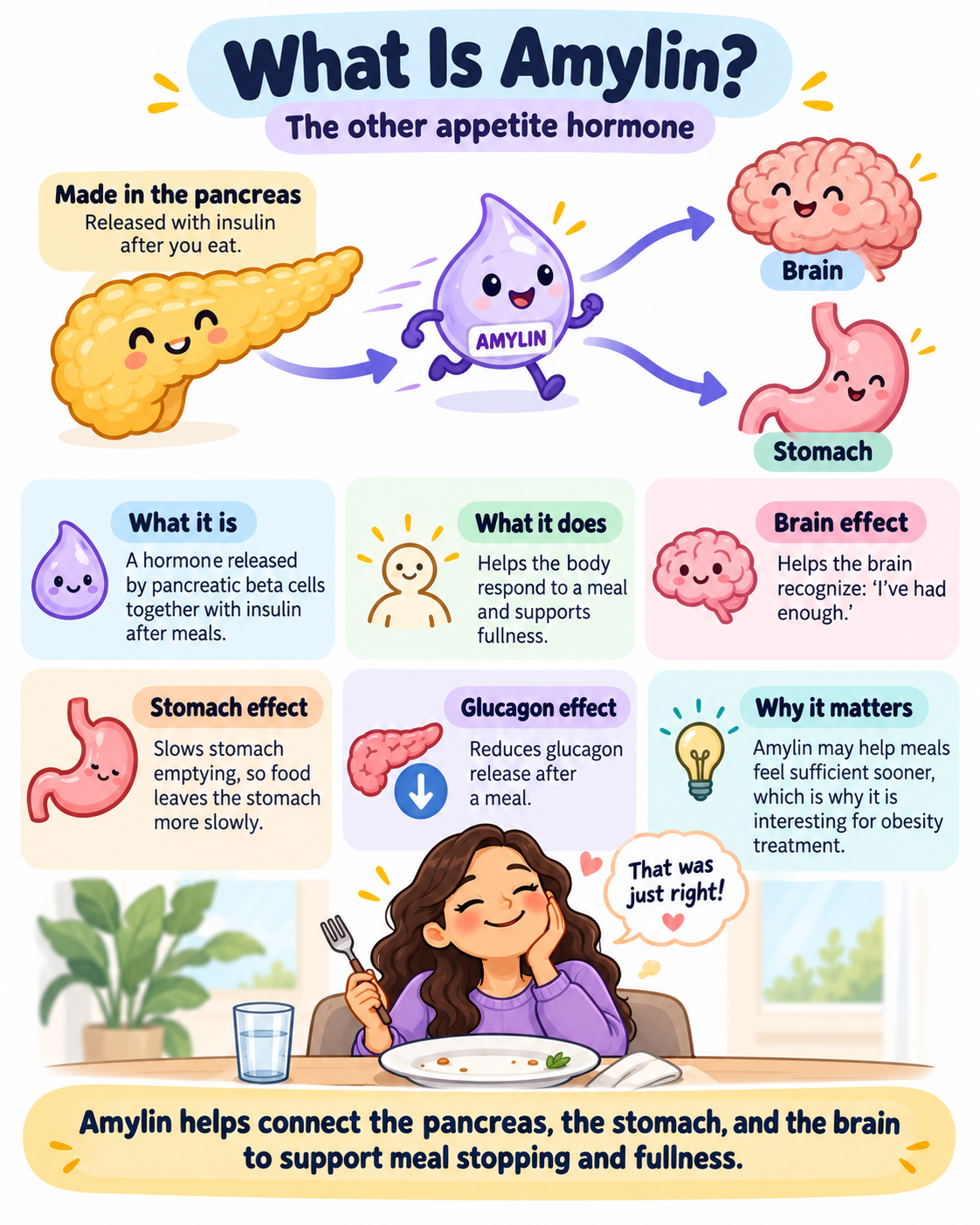
GLP-1 gets most of the attention in weight-loss medicine, but another hormone, amylin, has been quietly helping regulate appetite all along. Amylin is made by the pancreas and released together with insulin after we eat. Its role goes beyond blood sugar: it helps the body respond to a meal, slows the movement of food out of the stomach, and sends signals to the brain that contribute to the feeling that we have eaten enough. That makes amylin especially interesting in obesity treatment.
What does amylin actually do?
Amylin is released by the same pancreatic beta cells that produce insulin. After we eat, insulin helps move glucose out of the bloodstream and into cells, while amylin works alongside it with a different job. It helps slow gastric emptying, reduces the release of glucagon after a meal, and influences brain regions involved in appetite and satiation.
In simple terms, amylin helps send the message: “You have eaten. You can stop now.
That message matters because eating is not controlled by the stomach alone. The brain is constantly receiving signals from the gut, pancreas, fat tissue, and other organs about hunger, fullness, energy availability, and whether we should keep eating. Amylin is part of that conversation.
Hunger and satiation are not the same thing
One reason amylin stands out is that it highlights an important distinction: hunger makes us want to start eating, while satiation helps us decide when to stop. Amylin appears to play an important role in that second part.
That means an amylin-based treatment does not necessarily need to make food unpleasant or completely eliminate hunger. Instead, it may help a meal feel sufficient sooner. For someone trying to lose weight, that difference can be enormous, because the challenge is often not simply whether we know we should eat less, but whether the brain agrees that enough food has been eaten.
Amylin works in the brain
Amylin acts on specific receptors in the brain, particularly in areas involved in appetite regulation and meal termination. One important region is the area postrema, located in the brainstem. This area can detect circulating hormones and other signals from the body and help regulate eating behavior.
Amylin signaling also interacts with broader neural networks involved in satiety. So when we talk about amylin as an “appetite hormone,” we are really talking about a signal that helps connect what is happening in the pancreas and digestive system with what the brain perceives as enough food. That is one reason obesity researchers are so interested in it.
How is amylin different from GLP-1?
There is some overlap. Both GLP-1 and amylin can reduce food intake and slow gastric emptying, and both communicate with the brain. But they are different hormones, produced in different places and acting through different receptors.
GLP-1 is an incretin hormone released mainly from the gut after eating, while amylin is a pancreatic hormone released together with insulin. Because the pathways are different, scientists can potentially target both at the same time rather than simply increasing the strength of one signal. That is the basic logic behind combining amylin-based treatments with GLP-1-based drugs.
Amylin is not new
Amylin itself has been known for decades, and a synthetic amylin analogue called pramlintide has been used in diabetes treatment for nearly two decades. What is changing now is the development of newer, longer-acting amylin drugs designed with obesity treatment in mind.
These drugs are designed for once-weekly dosing and stay active much longer than natural amylin. Examples include cagrilintide and eloralintide. Cagrilintide is a long-acting amylin analogue being developed by Novo Nordisk, while eloralintide is a selective amylin receptor agonist being developed by Eli Lilly. Both are part of a broader effort to see how strongly the amylin pathway can influence body weight.
Why combine amylin with other weight-loss drugs?
The idea is relatively simple: weight regulation is controlled by many biological systems, so instead of asking one hormone to do everything, researchers are increasingly combining different pathways.
An amylin-based drug may strengthen the signal that a meal is sufficient, while another drug may influence hunger, insulin signaling, or energy metabolism through a separate pathway. That is why amylin is being combined with drugs such as semaglutide and tirzepatide.
For example:
CagriSema combines cagrilintide with semaglutide.
EloraTZP combines eloralintide with tirzepatide.
In the case of EloraTZP, the name comes directly from the two components: Elora from eloralintide and TZP from tirzepatide.
I have discussed those combinations elsewhere, but what matters here is the broader point: amylin has become a serious obesity-treatment target in its own right.
Why I find amylin interesting
For years, weight loss was often presented as a simple equation: Eat less. Move more. Have enough willpower. But hormones like amylin show why that explanation is incomplete.
The brain is constantly receiving biological signals that influence when we start eating, how rewarding food feels, how much we eat, and when we finally feel that a meal is enough. Amylin is one of those signals.
It does not mean calories and behavior do not matter, but it helps explain why eating less can feel easy for one person and extraordinarily difficult for another. And that is what makes amylin so interesting: it is not simply another new weight-loss drug target, but another reminder that appetite is biology.
Eloralintide, cagrilintide, and their combinations are investigational and not FDA-approved. This article describes emerging research and is not medical advice.
References
Walker CS, et al. Amylin: emergent therapeutic opportunities in overweight, obesity and diabetes mellitus. Nature Reviews Endocrinology. 2025;21(8):482–494.
Davies MJ, et al. Cagrilintide–semaglutide in adults with overweight or obesity and type 2 diabetes. New England Journal of Medicine. 2025;393(7):648–659.
Bailey CJ, Flatt PR, Conlon JM. Long-acting amylin-related peptides as therapies for obesity and type 2 diabetes. Peptides. 2026;196:171480