
The Science of Food Noise
Why Your Brain Won't Stop Talking About Food — and than there was glp-1
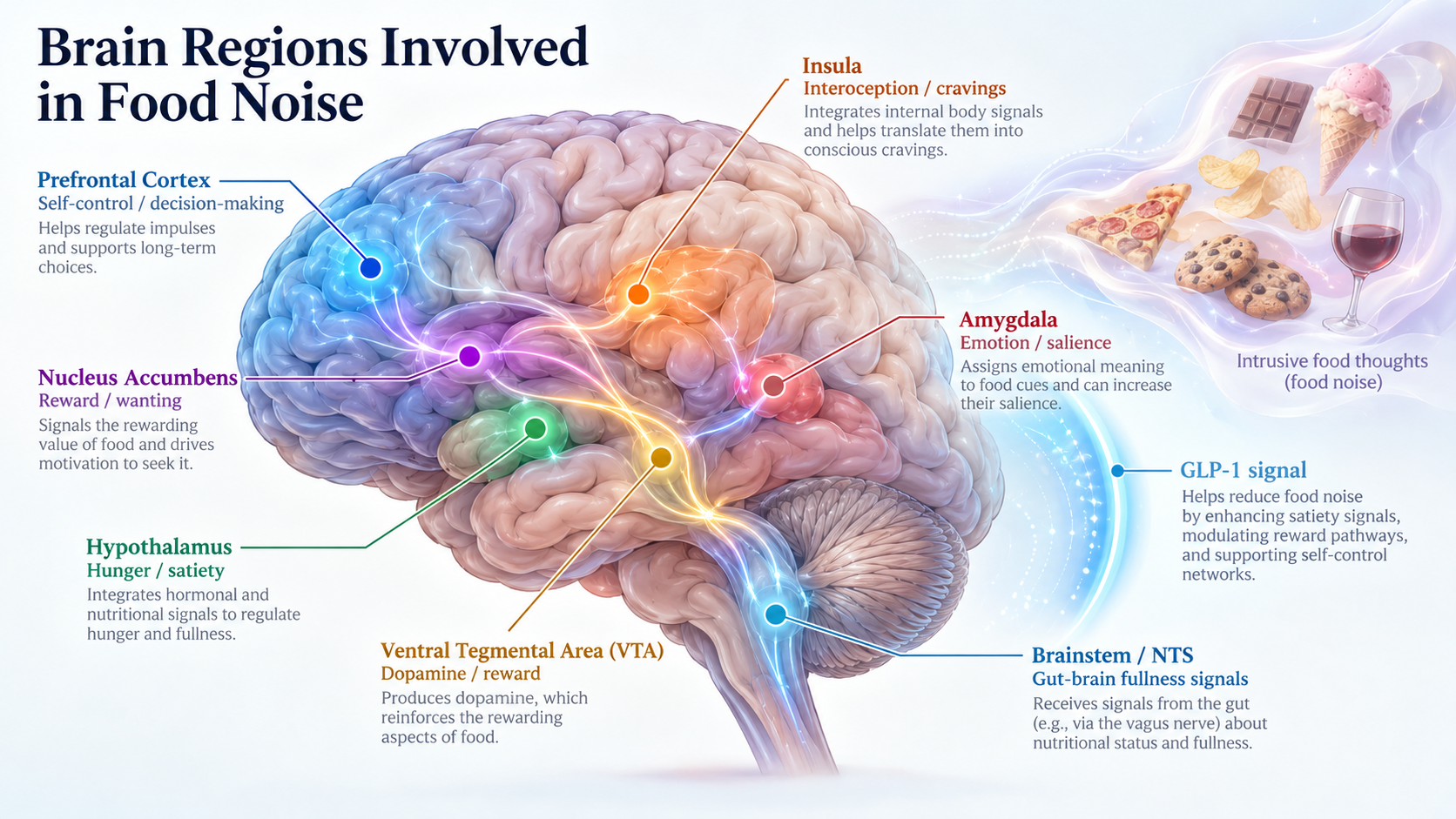
There is a particular kind of exhaustion that comes from being told to “just eat less.” Anyone who has spent years dieting knows the problem was never really knowing what to do; it was living with a voice in your head that had completely different plans.
That voice now has a name: food noise.
For the first time, science is beginning to explain where it may come from, why it can be so difficult to ignore, and why a new class of medications seems to quiet it so dramatically in some people.
A Feeling Many People Recognize but Could Never Name
Food noise is the experience of thinking about food far more than the situation seems to call for, whether that means planning what to eat next, negotiating with yourself over a snack, or feeling a completely full stomach somehow overruled by a sudden craving for chocolate.
It is not necessarily the same as hunger.
People often describe finishing a satisfying meal and, minutes later, finding themselves thinking about a specific food for no obvious reason at all.
Researchers do not yet have one formal definition of food noise, but the term is increasingly used to describe persistent, intrusive food-related thoughts that can feel disconnected from actual physical need.
What has made the topic especially interesting is how many people report that those thoughts suddenly became much quieter after starting a GLP-1 medication such as Ozempic or Wegovy.
The Hormone Behind the Story

GLP-1, or glucagon-like peptide-1, is a naturally occurring hormone released after eating. It helps regulate blood sugar and contributes to the signals that tell the brain we have had enough to eat.
Scientists have studied GLP-1 for decades, particularly in relation to diabetes and insulin regulation.
Natural GLP-1 does not remain active for very long, however, so researchers developed longer-lasting medications that activate the same receptor for much longer periods.
That changed everything.
Instead of acting only briefly after a meal, these medications can influence GLP-1 receptors throughout the body and brain for hours or even days.
The gut communicates with the brain partly through the vagus nerve, which carries information about digestion and fullness to a brainstem region called the nucleus tractus solitarius, or NTS.
What researchers later discovered was even more interesting: the brain does not simply receive GLP-1 signals from the gut. Certain neurons in the brainstem produce GLP-1 themselves, and GLP-1 receptors are found in many brain regions involved in appetite, motivation, decision-making, and reward.
That is where the food-noise story becomes particularly interesting.
Following the Wiring Into the Brain's Reward System
Research has shown connections between GLP-1-producing neurons in the brainstem and areas including the ventral tegmental area and nucleus accumbens, two important parts of the brain's reward system.
These regions are involved in motivation, pleasure, craving, and addiction.
In animal studies, activating GLP-1 signaling in these reward pathways reduced food intake, particularly the desire for highly rewarding foods, while blocking that signaling could increase eating.
Human brain-imaging studies have pointed in a similar direction.
When people with obesity were shown pictures of tempting, high-calorie foods, activating GLP-1 receptors was associated with reduced activity in brain regions involved in reward and craving, and participants later ate less.
One particularly interesting idea is that GLP-1 may influence the difference between “wanting” a food and actually “liking” it.
The intense anticipation of food may decrease, while the actual enjoyment of eating does not necessarily disappear.
In other words, the chocolate may still taste good, but your brain may stop talking about it for three hours before you eat it.
Beyond Food: Cravings and Addiction
If food noise involves the brain's reward system, it makes sense that the effect might not stop with food.
Some people taking GLP-1 medications report reduced interest in alcohol, nicotine, shopping, or other compulsive behaviors.
Researchers are now studying whether appetite, craving, and addiction share some of the same underlying brain pathways and whether GLP-1 medications might influence all of them.
Clinical research has already begun exploring GLP-1 medications in people with substance-use disorders, including alcohol and opioid use.
The findings are still developing, but they raise an intriguing possibility: GLP-1 medications may be doing more than simply making people feel physically full. They may also be turning down some of the brain's “wanting” signals.
Could Food Noise Also Be a Wandering Mind?
A newer and more speculative theory suggests that food noise may also be connected to the brain's default mode network, a system that becomes active when we are not focused on a particular task.
This is the network involved in daydreaming, planning, remembering, worrying, and mentally rehearsing the future.
Because the human mind spends a surprising amount of time wandering, one theory is that food noise may occur when this wandering repeatedly becomes focused on food.
Instead of simply thinking, What am I doing later?, the brain starts running a loop of What should I eat later? Should I have that snack? Maybe I should get ice cream.
This idea is still much more theoretical than the research on reward pathways, but it raises an interesting question.
Some researchers have suggested that GLP-1 medications may influence activity in this network, while mindfulness meditation has also been associated with changes in default-mode-network activity.
The possibility that a medication and a mental practice might affect overlapping brain systems is fascinating, although much more research is needed before we know how important that connection really is.
Why Doesn't Everyone Experience It?
One of the biggest unanswered questions is why the effect varies so much from person to person.
Some people describe an almost immediate quieting of food thoughts, while others notice only modest changes or cannot tolerate the medications because of side effects.
Researchers are investigating several possible explanations, including differences in natural GLP-1 levels, genetics, receptor sensitivity, and individual brain responses.
There is still a great deal we do not know.
Why This Matters
For decades, people struggling with obesity were often told that the problem was simply a lack of discipline or willpower.
The emerging science of GLP-1 medications tells a much more complicated story.
Hunger, fullness, reward, craving, hormones, memory, and brain signaling all interact to influence eating behavior, much of it outside conscious control.
That does not mean personal choices no longer matter, but it does mean that those choices are being made inside a biological system that can make eating more or less difficult from one person to another.
Food noise may therefore be more than an annoying habit or a failure of self-control.
It may be one visible sign of how strongly the brain's appetite and reward systems can influence behavior.
And perhaps that is the most important lesson of all: sometimes the problem was never that we did not know what to do; the problem was that our brains would not stop talking about food long enough to let us do it.
References
Hayashi, D., Kort, J., Robles-Martinez, I. M., Orabueze, D., Bakhl, K., & Masterson, T. D. (2026). "And just like that, quiet": A content analysis of TikTok videos on food noise. Nutrition & Diabetes, 16(1), 16.
Alhadeff, A. L., Rupprecht, L. E., & Hayes, M. R. (2012). GLP-1 neurons in the nucleus of the solitary tract project directly to the ventral tegmental area and nucleus accumbens to control for food intake. Endocrinology, 153(2), 647–658.
Cook, G. Quieting “food noise”: How GLP-1s and mindfulness rewire the default mode network (DMN) and reward circuits. PMCID: PMC12770913.