
Glucagon: The Hormone That Ruined My Simple Explanation
Wait… isn’t glucagon the hormone that raises blood sugar?”
Glucagon seemed simple to me. Insulin lowers blood sugar, glucagon raises it. Done. Or so I thought. To be fair, that is how it is usually described. Argh.
Then I started reading about retatrutide and saw the phrase “GIP, GLP-1, and glucagon receptor agonist.” People, make up your mind. Is it glucagon or an agonist?
At this point I had to laugh. I am already injecting myself with a drug that is not FDA-approved, and apparently I also do not fully understand what all the words mean. Excellent.
My first reaction was basically: Wait. What? Why would a weight-loss drug activate the glucagon receptor? Isn’t glucagon the hormone that raises blood sugar? That sounded slightly backwards, which of course meant I had to understand it.
So what is glucagon?
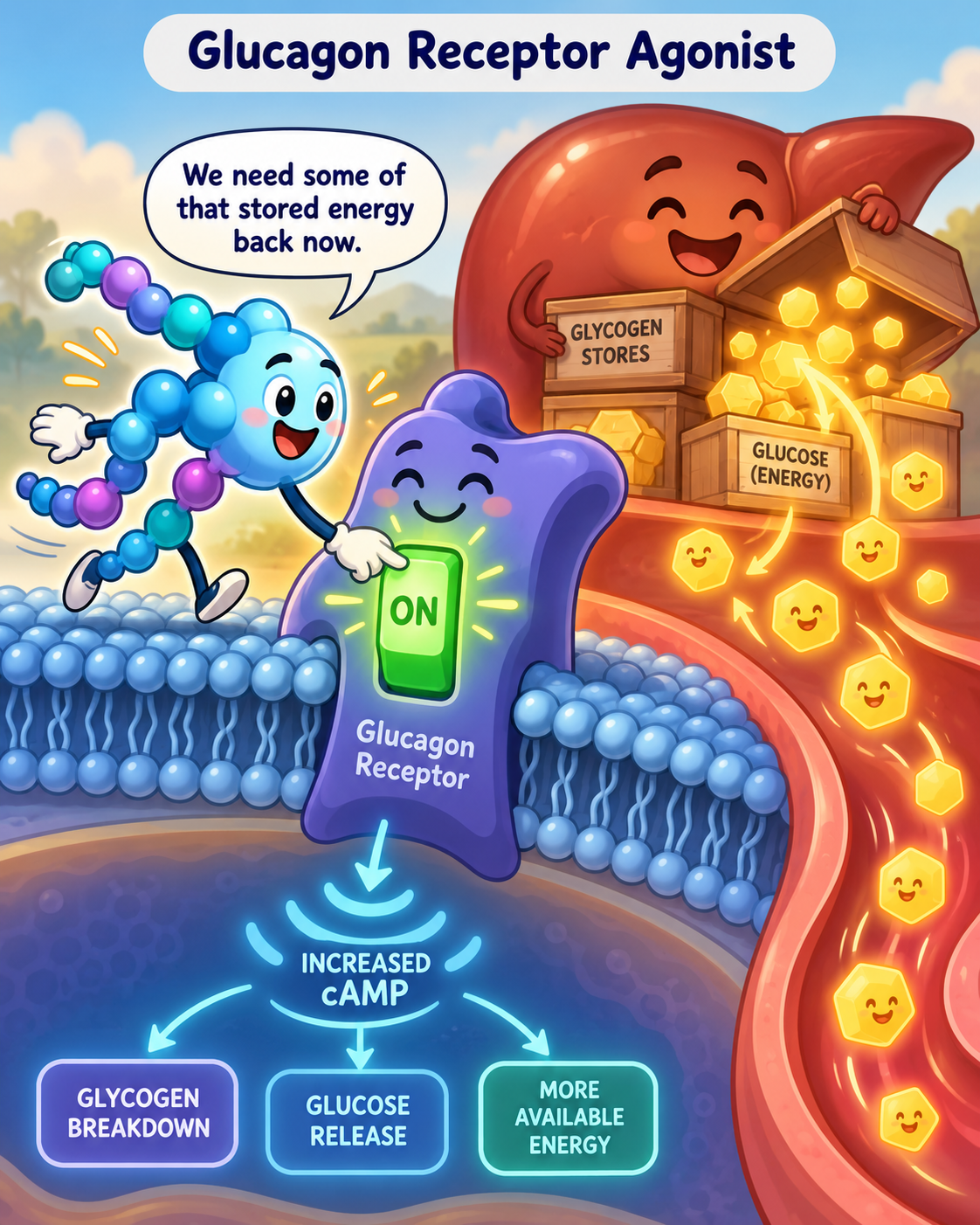
Glucagon is a hormone made mainly by alpha cells in the pancreas. Its job is to make sure we have enough fuel available when we need it. If blood sugar starts to fall, glucagon tells the liver, “Okay, stop hoarding. Release some glucose.” The liver then breaks down stored glycogen and releases glucose into the bloodstream.
Glucagon says, “We need some of that stored energy back now.”
And I say: finally, a hormone speaking my language.
So if insulin is the hormone saying, “Store the energy,” glucagon is the one saying, “We need some of that energy back now.” So far, so good. But that is not the whole story.
Retatrutide does not contain glucagon
This part is important. Retatrutide is not a mixture of GLP-1, GIP, and glucagon. It is a single molecule designed to activate three different receptors: the GLP-1, GIP, and glucagon receptors.
An agonist is simply something that activates a receptor and makes it signal. So retatrutide is basically knocking on three different hormonal doors at once.
I just have to say - Very ambitious little molecule.
Why activate the glucagon receptor at all?
Because glucagon does more than raise blood sugar. It is also involved in how the body handles and uses energy. Researchers are interested in whether activating the glucagon receptor can influence energy expenditure, fat metabolism, and liver fat, rather than only appetite.
That is where retatrutide becomes especially interesting. Semaglutide targets the GLP-1 receptor, tirzepatide targets the GLP-1 and GIP receptors, and retatrutide targets all three: GLP-1, GIP, and glucagon.
So the idea is not simply, “Make me less hungry.” It may also be, “And while we’re at it, can we change how the body uses energy?”
Now that got my attention.
But wait… doesn’t glucagon raise blood sugar?
Yes. Which is exactly why I found this confusing at first. Activating the glucagon receptor can increase glucose production by the liver, and that does not sound like something you would want in a drug being studied in people with obesity and diabetes.
But retatrutide activates the GLP-1 and GIP receptors at the same time. Those pathways help regulate glucose and support insulin secretion. So the whole thing appears to be about balance: scientists are trying to capture some of the metabolic effects of glucagon signaling while using the other pathways to help keep glucose under control.
Biology, apparently, enjoys making everything more complicated than necessary.
Glucagon may be the “burn” side of the equation
GLP-1 gets a lot of attention because of appetite. You feel less hungry, you get full sooner, and the food noise gets quieter. Glucagon brings a different idea into the picture.
Instead of only asking, “How do we make someone eat less?” researchers are also asking, “Can we change how the body uses the energy it already has?”
That is why the glucagon receptor is so interesting in retatrutide. It may contribute something that GLP-1 and GIP do not do in quite the same way.
Why I find glucagon interesting
I thought glucagon had one job: raise blood sugar. Very straightforward. Very boring.
Apparently not.
Now it is a key part of the three-receptor strategy behind one of the most interesting experimental obesity drugs. So I have officially upgraded glucagon from “insulin’s annoying opposite” to “Okay, maybe you’re more interesting than I thought.”
And honestly, this is what I love about biology. The moment you think you understand something, another pathway shows up and ruins your nice, simple explanation.