
Food Noise vs. GLP-1: Finally, My Brain Went Quiet
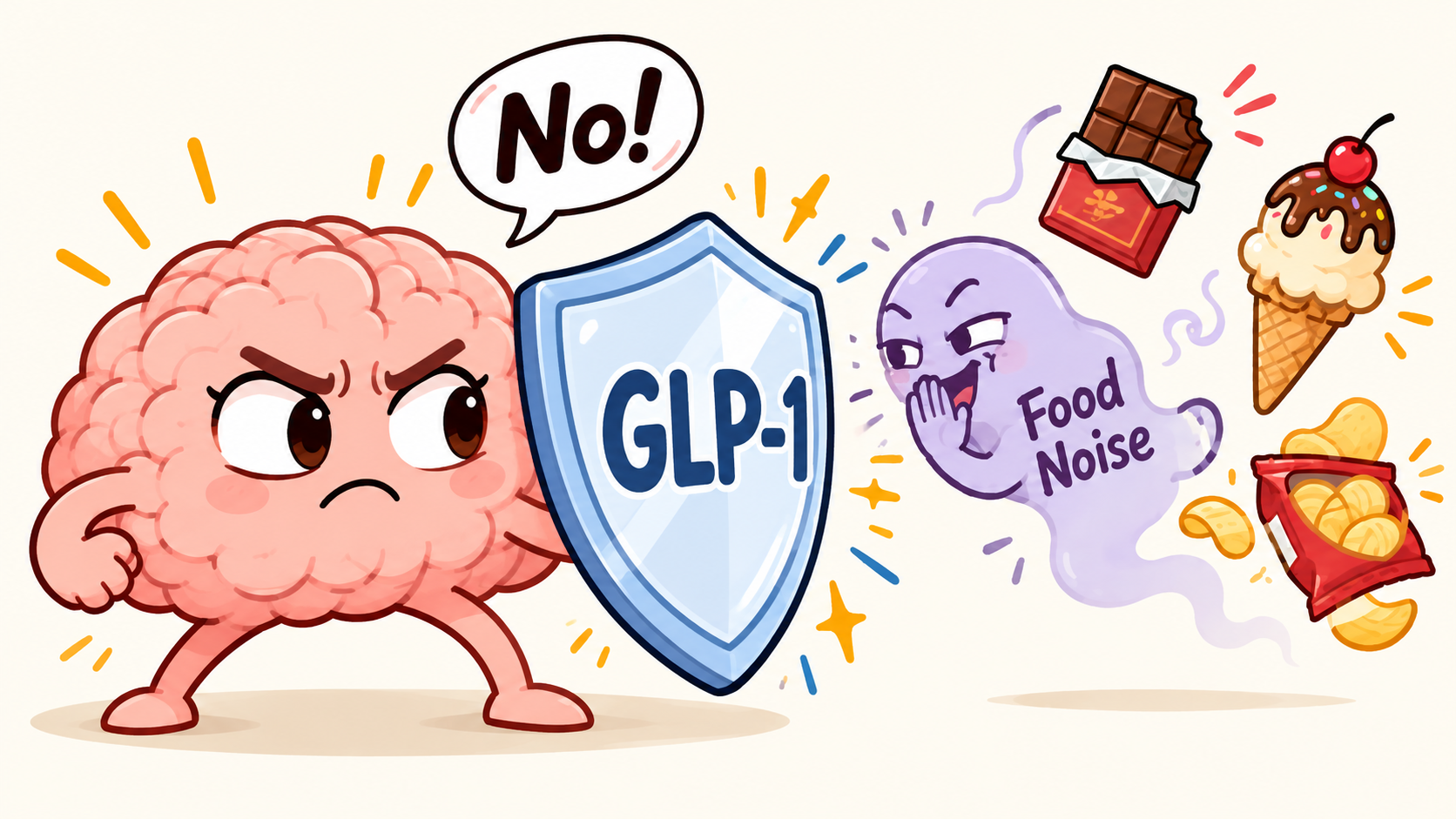
GLP’s and Food Noise
I have to admit that I absolutely hate it when someone says, “Just eat less and exercise more.”
Really? Thank you. You must be related to Einstein. ARRRRGH.
Seriously, most of us know that eating less and moving more can help with weight loss, but knowing what to do and actually doing it every single day are two very different things — especially when there is another voice living in your head with a completely different agenda.
That voice, at least for me, is food noise.
Am I constantly hungry? No, of course not. Physical hunger was never really the whole problem — it is this little sucker called food noise.
I can finish dinner, feel perfectly satisfied, or sometimes even overfull, and then my brain suddenly announces that chocolate would be a fantastic idea.
Excuse me? I am already full. Brain, did you not get the memo? Full means full.
Apparently not, because now it starts whispering:
There is chocolate in the drawer.
And my answer is, Stop it. I will explode if I eat more chocolate.
But the voice only gets stronger:
Are you sure? There is chocolate in the kitchen. Remember the chocolate? It would be a shame to ignore the chocolate.
And suddenly I am thinking about chocolate for the next three hours, as if I have accidentally joined some kind of chocolate cult that refuses to let me leave.
Food noise also seems to love emotions, because I can eat when I am sad, angry, stressed, frustrated, happy, celebrating, or simply having a perfectly normal weekday that apparently deserves dessert.
For years, I tried diets, rules, restrictions, fresh starts, and plenty of versions of Tomorrow I’ll be good, but somehow the food noise always found a loophole.
Then came Zepbound.
I had already tried Wegovy, which did not work especially well for me because I mostly felt nauseated and lost weight partly because I felt sick, but Zepbound was completely different.
Within hours of taking it, something remarkable happened: the food noise became quiet.
I once told a physician that I noticed the effect within hours, and he told me that could not happen that quickly, which was interesting because apparently my brain had forgotten to consult him first.
For the first time, I could look at food without beginning a full committee meeting in my head about whether I should eat it, how much I should eat, whether I would regret it, and whether I should start a new diet on Monday.
Over time, I lost around 50 pounds, but what fascinated me almost as much as the weight loss was what had happened inside my brain.
Scientists are beginning to understand some of this. GLP-1 receptors are found in brain regions involved in appetite, reward, decision-making, and the “wanting” and “liking” of food, and researchers are studying how these medications may influence dopamine-related reward pathways.
People taking GLP-1 medications have also reported reduced cravings for things other than food, including alcohol, nicotine, and other compulsive behaviors, which has led researchers to investigate whether some of the same brain circuits are involved in appetite, reward, and addiction.
For me, that research gave a scientific explanation to something I already knew from experience: Zepbound did not simply make me less hungry — it made food less interesting.
Eventually, however, Zepbound and I had our breakup because the lower doses stopped working well enough, while the higher doses caused side effects that became too much for me.
After I stopped, the food noise came back — and eventually so did about 14 pounds, because apparently they had missed me.
That is what eventually brought me to Retatrutide, and once again I experienced something very familiar.
Before taking it, I could be seriously thinking about ice cream, and several hours later I would suddenly realize that I had completely forgotten about it.
Yes, Retatrutide had kicked that voice out of my brain.
See ya, sucker.
I did not heroically resist the ice cream, fight with myself for hours, or stand in front of the freezer whispering motivational quotes.
The thought simply disappeared.
HEHEHE.
Researchers still do not have a formal scientific definition for “food noise,” and not everyone taking GLP-1 medications experiences the same dramatic quieting of food thoughts. But my own experience changed the way I think about weight loss, because I no longer believe the struggle is simply about knowing what to eat or having enough willpower.
For me, the biggest change was discovering what life feels like when my brain stops running a 24-hour food channel I never subscribed to in the first place.